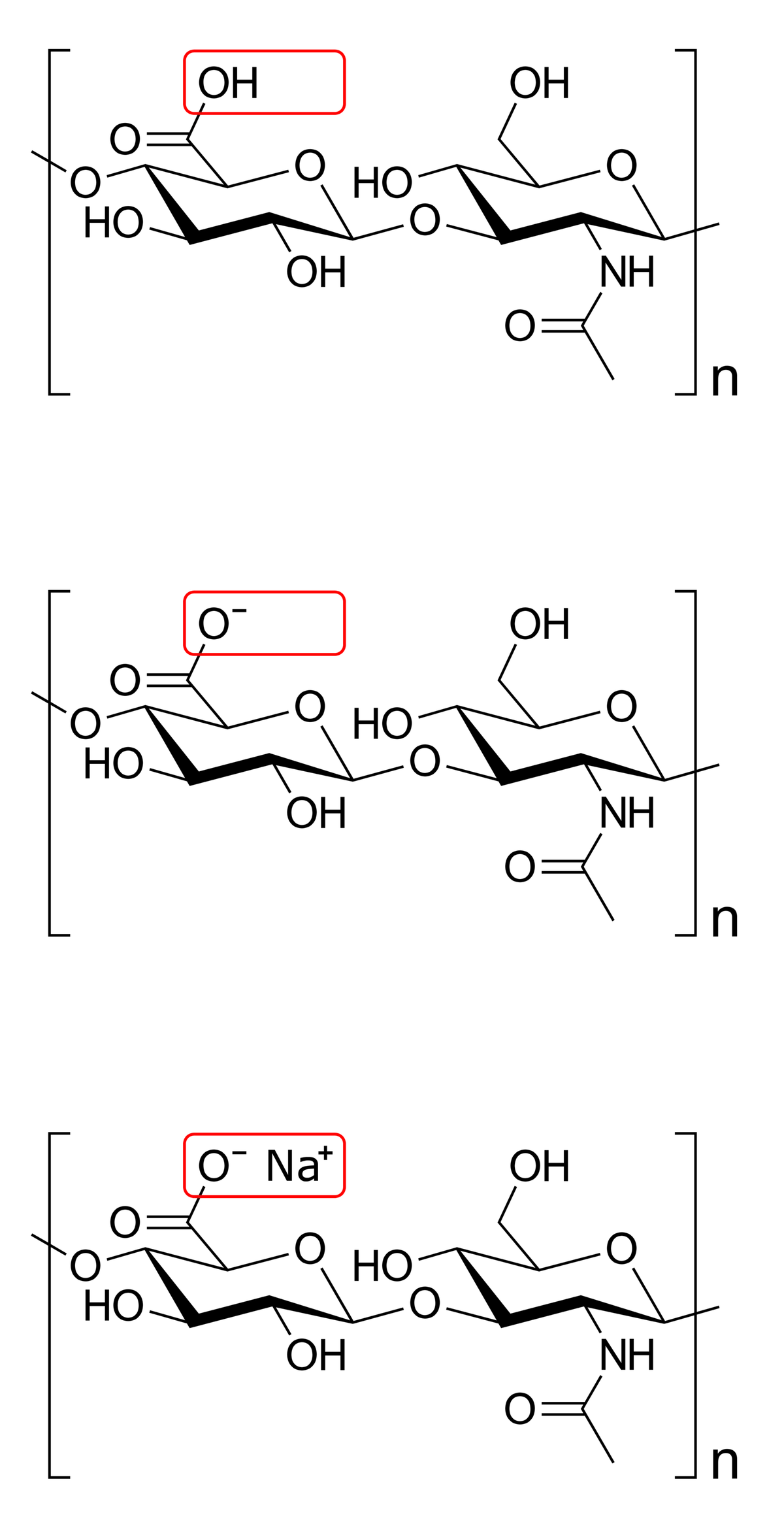

Hyaluronic acid, HA for short, is a sugar the skin makes itself, and its job is holding water. On a label, the number to check is molecular weight. Size decides where the chains can travel. A 2016 Raman spectroscopy study in Skin Research and Technology found small chains slip past the skin's surface while large ones stay on top. Weight changes placement, not the water-holding job.
That placement rule shapes what a serum can do. The study, run at the University of Reims Champagne-Ardenne in France, tracked three chain sizes with Raman micro-imaging. Chains of 20 to 300 kDa crossed the stratum corneum, the skin's outer layer. Chains of 1000 to 1400 kDa did not. The same placement logic applies to filters, as in what avobenzone and oxybenzone actually do on a sunscreen label.
The market has noticed. HA serums fill the shelves of New York pharmacies, from Soho beauty halls to Brooklyn corner stores, each with its own depth story. The label science is easier to follow than the marketing. The beauty news section keeps score on the studies.
What Does Hyaluronic Acid Do in Skin?
It holds water, and it holds a lot of it. A 2012 review in Dermato-Endocrinology calls hyaluronic acid the key molecule in skin moisture, with a unique capacity for water retention. Turgor and pliability in young skin trace back to that water store. Aging and daily outdoor wear drain it.
The review, by Papakonstantinou and colleagues in Greece, maps how skin builds and breaks the sugar down. The authors argue that a full picture of that turnover, layer by layer, would let formulators modulate skin moisture in a rational way. The store sits in more than one layer of skin, and each layer runs its own metabolism.
Why Does Molecular Weight Change the Game?
Weight decides placement. In the Reims study, Raman micro-imaging followed three HA sizes into skin sections. Low-weight chains of 20 to 300 kDa passed through the stratum corneum. High-weight chains of 1000 to 1400 kDa stayed out entirely. The tool could see each chain's landing spot without dyes or labels.
- 20-300 kDa: crossed the stratum corneum in the Raman test
- 1000-1400 kDa: held at the surface, impermeable in the same test
- Label read: small chains mean upper-layer travel, large ones mean surface film
What Can a Cream Not Do Here?
A cream cannot push the big chains deep. The 2016 data put them at the surface, and that is where their effect ends. Claims that a serum rebuilds deep structure stretch past the study. The middle chain sat between the two, a clear spread across all three sizes. Deep placement means an injection, a procedure that sits outside the cosmetic aisle. This connects to our earlier piece, Salon Licensing Changed on January 1: What California's New Rule Means.
Surface hydration has its own value. The 2012 review ties moisture loss to the visible signs of aging, and water-binding is the step a serum can support. What it cannot support is a claim below the depth the Raman study measured.
How Should the Label Be Read, Then?
Look for size language. Most jars do not print a kDa range, so weight claims live in the marketing words around the ingredient name. The Raman data give you the check. A high-weight claim means the surface. A low-weight claim means the upper layers. Anything deeper is not on the current chart.
The 2012 review adds the caution from the other side. HA metabolism is complex, with many control points, and rationally tuning skin moisture remains a research goal. A label that promises more than placement is writing past both papers. Readers following this should also see The Fragrance Line on Every Label: What MoCRA's Allergen Rule Will (and Won't) Change.
Conclusion: One Sugar, One Number to Check
Hyaluronic acid earns its shelf space as a water binder, per the 2012 review in Dermato-Endocrinology. The 2016 Raman study adds the practical rule. Weight sets the destination: 20 to 300 kDa crossed the surface, and 1000 to 1400 kDa stayed on it. Read the weight claim first, and the promise sizes itself.